
By Emily Sok, Published January 29, 2024
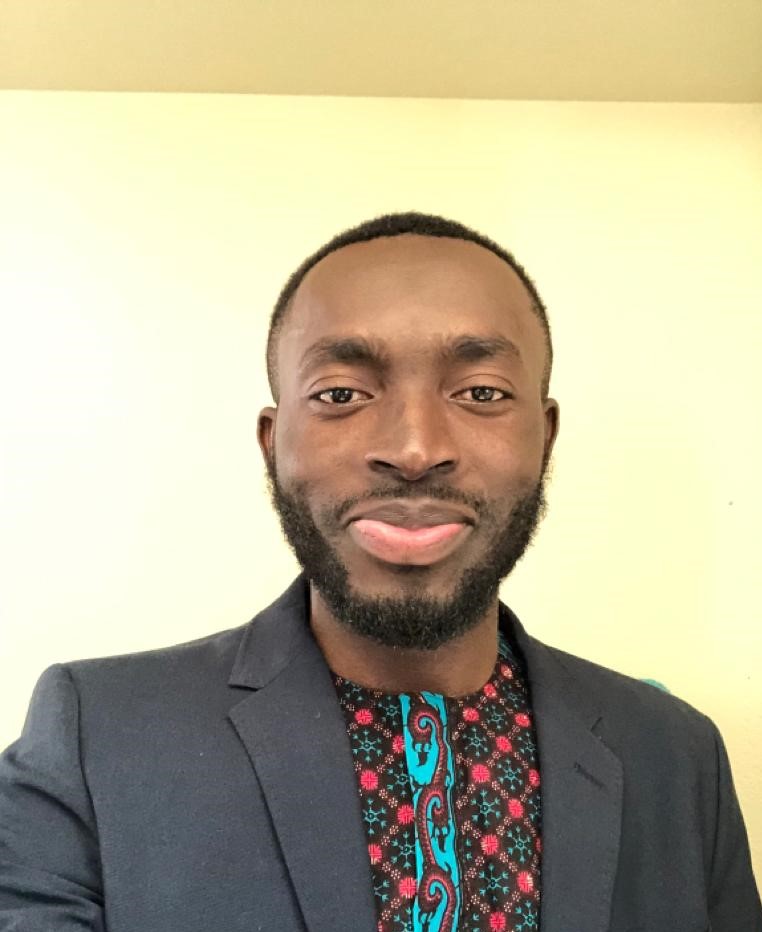
An Interview with Mohammed Iddrisu
Collaborate with Mohammed: msiddris@asu.edu
As of late December, 2023 when I talked with Mohammed about his research interests and community and public writing work, Mohammed is a finishing doctoral student at Arizona State University. The transcript below is a wonderful conversation that I am proud to share on our website!
Are there any community or public writing experiences that you could highlight?
I will talk about a community writing activity that I engaged in. I was part of the Women’s March in El Paso that sprang up on the back of the election of Donald Trump. I was then new in the U.S., and the kind of writing I was doing was social media writing. So, I engaged with different communities who had concerns about the kind of rhetoric that he was espousing. The kind of writing I did sought to frame our messages to target to different public audiences that we were trying to rally and organize to participate in a march. That was my very first community writing experience.
I think it was a success because the goal at the end of the day was to convey a message to a number of people, and to engage in advocacy that sought to protect the interests of a number of communities that had concerns, which were primarily with the election of Donald Trump. Those communities were targeted. I am Muslim, and so, in the election campaign, there was a lot of talk about a Muslim ban. I had friends there in El Paso because I lived near the U.S.-Mexico border and they also had different concerns. This was a kind of shared interest that brought us together. We felt that particular communities might be targeted by the federal government’s policies.
That was the initial community writing activity that I engaged in, and it was both ‘community’ and ‘public’, because it was people coming together with a shared interest and seeking to use writing to engage with a wider public audience and advocacy.
I have done some other community writing projects as well. One recent project was related to my master’s thesis, where I worked with Muslim women who wear the hijab. The writing was mainly to amplify their voices in terms of their experiences with the public wearing of hijab, including how visible they are, and how people tend to use that to target them in different ways. After the project, I managed to work with some professors who had their students visit the Islamic Center at El Paso to engage with the Muslim community and build some intercultural knowledge. The goal was to get students to engage with the Muslim community and understand what the Muslim community is about among other things. My hope was that, if there is understanding between the two institutions and people, especially students, who are affiliate with both institutions get to learn from and about one another, there will be better communal relationships. This is particularly important because universities are always talking about issues of diversity, equity, inclusion, and access. I don’t see the point of giving people access, but not affording them the ability to realize their own potentials within the institution because others discriminate against them.
Why do you believe community and or public writing are important?
The potential I see in this kind of work is that it becomes an opportunity really, for scholars and researchers and teachers to work directly with particular communities, to name specific problems that those communities are dealing with, and to work collaboratively and actively, to find what should be wise outcomes and options in response to those concerns. We as scholars, teachers, or researchers also have a commitment to this work. So, the real potential that I see in community writing and public writing is the fact that it becomes an opportunity for collaborative work between researchers and communities. We can deal with problems and are able to impact communities in transformative ways. Invariably, this also shapes our own theories and methods within our disciplines and policies within our institutions.
As an example, almost every university makes the claim that they are interested in student or community engagement. If we are interested in this, what is the outcome of that interest? How do we hope that student’s community engagement that we do will shape our institutions in terms of our pedagogies, in terms of our policies and practices? On the other side of it, it is important because compels us to rethink our methodologies methods. Sometimes, when we’re thinking about research in community writing, methodologically, we tend to focus on the textual artifacts. We want to find what people are writing and here, we are thinking solely about alphabetic text. Yet people do other kinds of writing or literacies which are not necessarily constructed with alphabetic text. People take other approaches, which might be considered a form of writing, that can significantly impact the ways that we think, and the ways that knowledge is framed. It would be helpful to refine our methods in the ways that we think about community, in the ways that we
engage with community.
Are there any changes that you would like to see in community or public writing, broadly as a field?
One of the things that I am seeking to do in terms of disciplinary change is to minimize our obsession with textual artifacts. This is largely from my own dissertation work. I’m working with African American
communities in Ghana, who are engaged a host of creative literacy acts, who are reclaiming their humanity. What I am observing in my work is that in Ghana, when African Americans go to historic sites which are remnants of slavery and European colonialism, they enact certain literacies, certain literate practices that help them to feel human and to heal from their inherited and experienced traumas.
I can give an example. There is a particular site in Ghana called the Assin Manso Ancestral Slave River Park. At the site, many people whom I have observed walk barefoot, wash their hands, and feet in the river. That is the only place where I have seen them walking barefoot all the way from the trail to a river. This particular river is where captured Africans took their “last bath” to appear “clean” before being auctioned at slave markets. I see African Americans doing this, as people are telling them about their history. When I asked them about why they chose to do this, people have often responded that this is a form of agency.
They are coming back home to walk in the footsteps of their ancestors, and they are there on their own volition. This is a way of reclaiming that lost humanity that was denied their/our ancestors. Such a practice has gradually become very widespread among African Americans who live in Ghana.
I think it is this is a form of literacy that has healing potentials. People learn from doing these kinds of embodied practices in response to tragic historical violence and there is nothing written. It’s all bodily practices and it requires one to be on the ground to witness those practices instead of a written version to be produced before we theorize that written version. So, I think that, as a discipline, if we only rely on writing, we lose sight of this kind of grounded work that people are doing in specific places to achieve particular goals. Community literacies are usually certain kinds of meaningful social activities in pursuit of a particular goal, so if we focus only on the textual, we lose sight of these kinds of non-textual practices that people engage in. My hope is that as a discipline, we can expand or go beyond the written word and begin to theorize some non-textual practices that communities re-engaged in. There is a lot of benefit in terms of theorizing, in terms of our methods. That is one of the larger changes I see as necessary for our discipline.
Collaborate with Mohammed!
Get in touch with Mohammed by emailing: msiddris@asu.edu
If there were a project that you would like to collaborate with others on, what might that be?
I have a couple of projects that I would be interested in pursuing with others. One of them is to consider literacy practices of new mothers who are spouses of international students and do not have extended family support in caring for themselves and their babies. For new parents who are international graduate students, it is incredibly hard to take care of babies without some additional support and I know a couple of families that engage in quite creative practices of learning to care for themselves and their babies, especially in the first few months.
On the back of Covid-19, another project would be something around theorizing the literacies through which international student groups on university campuses construct community across digital spaces/apps like WhatsApp and the kind of infrastructure and learning that is needed to keep those groups active, meaningful, and impactful—intellectually, psychologically, financially, etc.—for their members over time. These are two areas I would be very interested in collaborating with others on.
Mohammed Recommends…
A Responsive Rhetorical Art: Artistic Methods for Contemporary Public Life by Elenore Long
Argument as Dialogue across Difference by Jennifer Clifton
Cultural Practices of Literacy: Case Studies of Language, Literacy, Social Practice, and Power Ed. Victoria Purcell-Gates
Mohammed Iddrisu’s Recent Publications:
A Rhetoric of Accent Fear and the Experiences of Multilingual Teachers of Writing by Eda Ozyesilpinar & Mohammed Iddrisu
On Parallel Paths: Learning through Case Studies in the Writing Pedagogy Course by Alyssa Devey, Christina Saidy; Mohammed S. Iddrisu, Seher Shah, and Marlene A. Tovar
Linguistic Injustice and Citizenship in Ghana: Epistemological Decolonization and Stranger-relationality as Rhetorical Arts of Resistance by Mohammed Iddrisu
User Experience and Transliteracies in Technical and Professional Communication by Laura Gonzales & Josephine Walwema, with E. Castillo, M. Iddrisu, C. Lerma, J. Wilhite (contributors).
Key Terms:
- Women’s March
- Muslim ban
- Repatriation
- Assin Manso Ancestral Slave River Park
- new mothers
- international students
- digital spaces
 The Virginia Community Writing Collaborative